SKANN: deep learning for vessel re-identification
- Open-Set Vessel Re-Identification from Underwater Ship-Radiated Noise with a Raw-Waveform Selective-Kernel Acoustic Neural Network (SKANN) and a Cross-Passage Evaluation Protocol
Open-set, cross-passage vessel re-identification from raw hydrophone waveforms, on the public IARA and ShipsEar corpora, with a fine-tuning experiment on Ocean Networks Canada recordings.
arXiv:2609.07399 [eess.AS], September 2026 · Read the preprint · DOI · artefacts on Zenodo · Wikidata · Summary on LinkedIn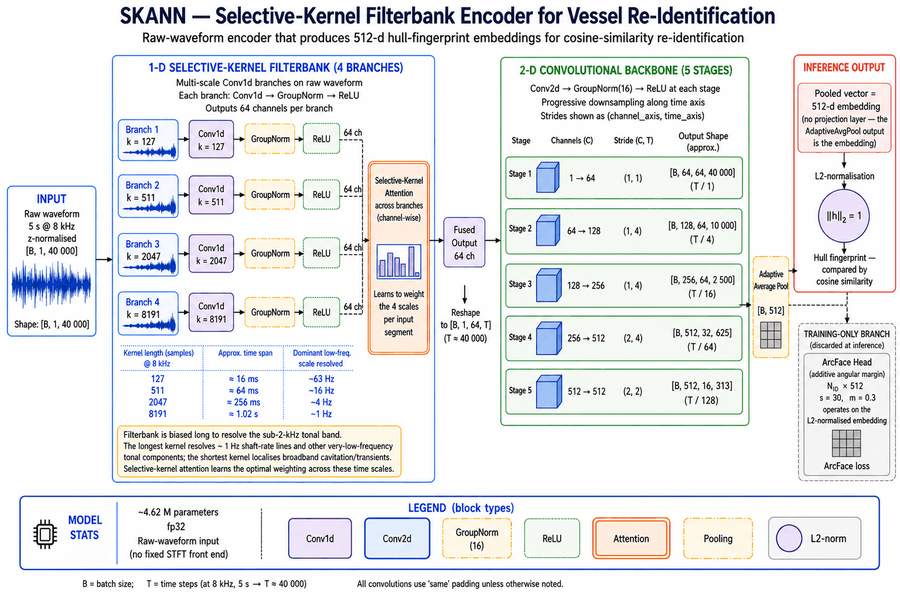
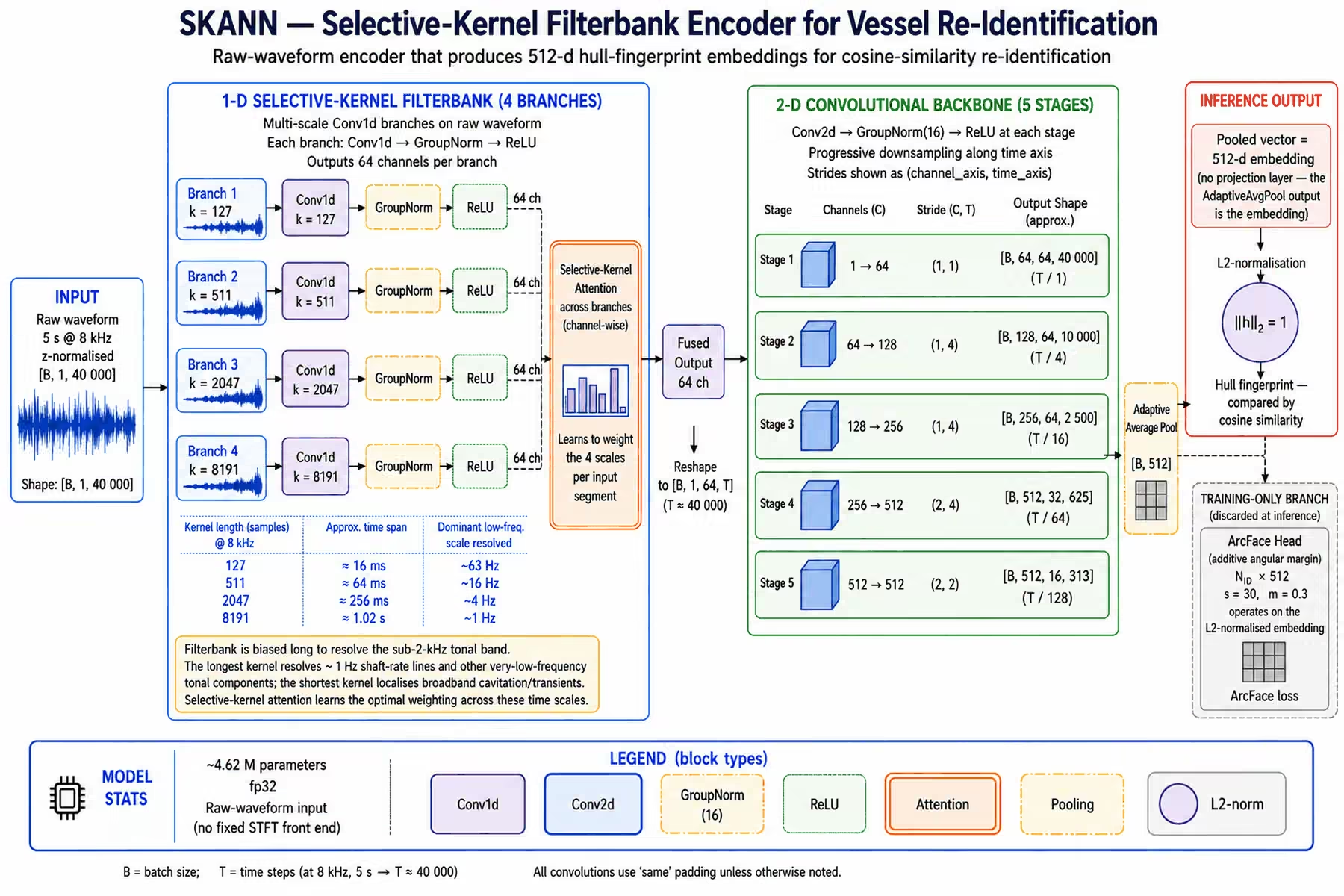
SKANN (Selective-Kernel Acoustic Neural Network) applies deep learning to underwater acoustics without spectrograms: it reads the raw hydrophone waveform, builds an embedding of hull identity, and decides whether a recording matches a vessel already in the gallery or belongs to one not seen before. Project page: oravontsystems.com/deep-learning.
Underwater acoustic target recognition has largely settled on classifying vessels by type, which does not answer whether a monitoring system has heard a particular hull before. This paper formalises that question as open-set, cross-passage re-identification on public hydrophone data, and specifies an evaluation protocol that closes the easiest routes to a flattering score — hull-disjoint splits, galleries and queries drawn from separate passages, and an audio-adjudicated transit-deduplication gate. Transit deduplication alone removes a 16–21 point apparent rank-1 advantage, larger than any difference between the methods compared. The results support analyst triage over a ranked shortlist, not identification.
SSR-Sim: blind tests of a submarine target-strength model
- Blind tests of a simple-body model of submarine target strength on open benchmarks
An analytical model of a submarine’s sonar echo, SSR-Sim, tested blind against boundary-element results and a lake measurement of the public BeTSSi benchmark hull.
arXiv:2611.25977 [eess.AS], November 2026 · Read the preprint · DOI · data: DOI 10.57967/hf/11704 · SSR-Sim at Oravont
The paper describes the method, in which a hull is cut into a few simple bodies whose closed-form echoes add in energy, and tests it on three open cases. For the rigid full-scale BeTSSi submarine at 1 kHz, a prediction fixed before the reference was opened agrees with boundary-element results to within 0.7 dB in every aspect sector from the bow to 150°, and is 5 dB high in the stern sector. For a tile-coated 1:15 model measured in a lake, a second blind prediction is within about 3 dB over aspects 0–120° at 5, 15 and 20 kHz; it is about 7 dB low at a resonance of the tile and in the bow sector. The tests cover the specular component and the coating model only.
Datasets
- SSR-Sim blind predictions of BeTSSi submarine target strength
Predictions of the target strength of the public BeTSSi benchmark submarine, recorded with their hashes before the reference results were opened.
S. Tyagi. Data set, Hugging Face, 2026. CC BY 4.0 · DOI 10.57967/hf/11704 · Hugging Face · preprint: arXiv:2611.25977 - Underwater-Acoustic-Synthetic-Dataset
12,000 five-second clips at 16 kHz: four vessel classes and ambient ocean noise, generated from physics-based acoustic models.
S. Tyagi. Data set, Hugging Face, 2026. CC BY 4.0 · DOI 10.57967/hf/11191 · Hugging Face · Article
Patents
A Machine Learning Tool for Ball-Bearing Fault Detection. Ball bearings are fundamental components in rotating machinery, yet their failure remains one of the leading causes of unplanned downtime and catastrophic machinery failures. Detecting faults at an incipient stage — before they escalate into critical issues — is essential for minimising disruptions and extending equipment life.
However, early fault detection is challenging because the vibration signatures of a healthy bearing and one with an emerging defect often appear strikingly similar. Common faults, such as cracks or pits on the outer race, inner race, or rolling elements, may initially generate subtle changes that are difficult to distinguish using conventional diagnostic methods.
Cite as: Tyagi S. Bearing Fault Detection. Official Journal of the Indian Patent Office, p. 20909, 27 May 2016. Patent Application No. 201621003344 A · IPO Grant No. 373427 · Named inventor; patentee DIAT Pune · Patent document (Figshare)
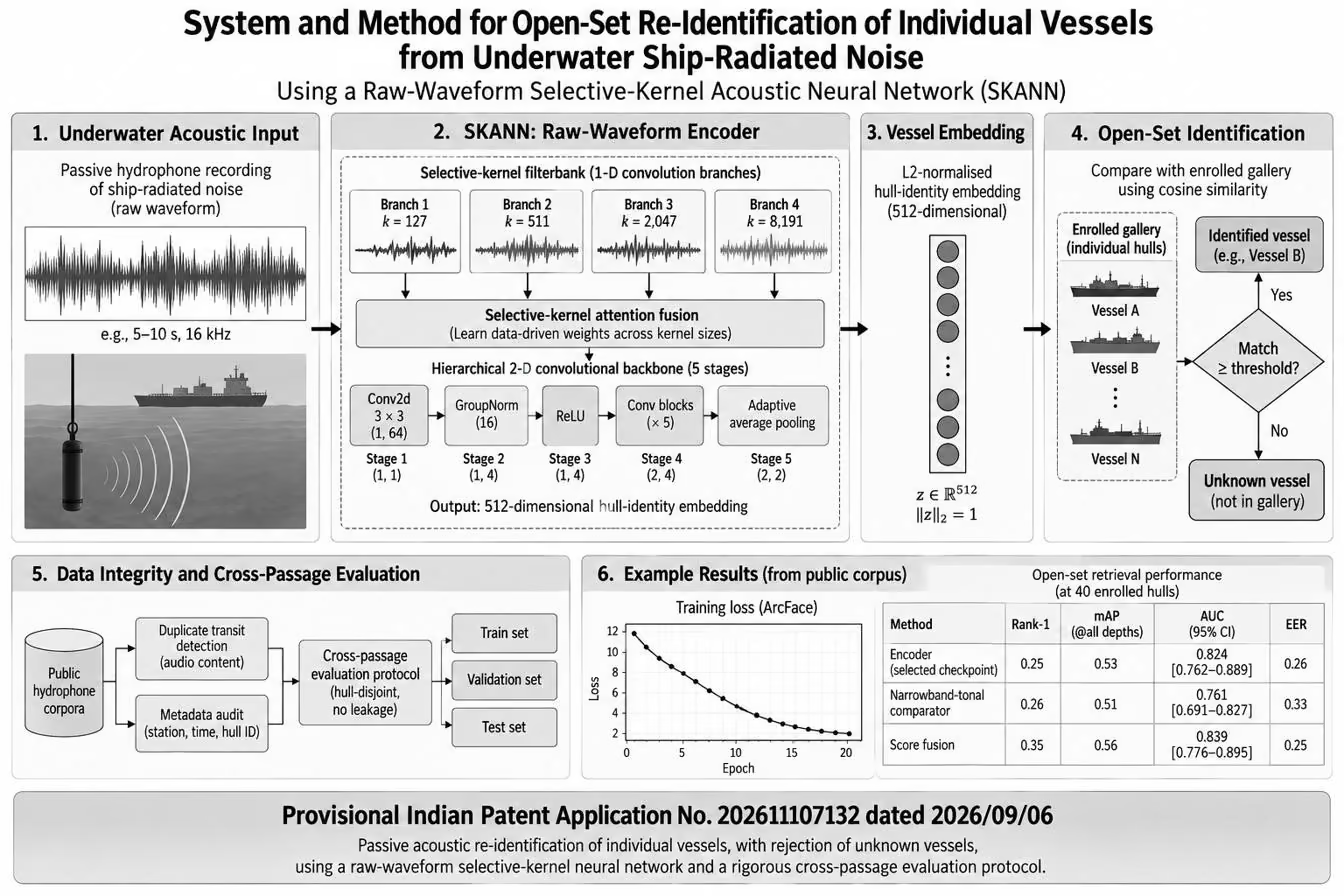
System and method for open-set re-identification of individual vessels from underwater ship-radiated noise using a raw-waveform selective-kernel acoustic neural network, and a cross-passage evaluation protocol therefor.
SKANN is a raw-waveform neural network for open-set re-identification of individual vessels from underwater ship-radiated noise. It builds a hull-identity embedding through multi-resolution selective-kernel processing, then matches a recording against an enrolled gallery by cosine similarity and rejects hulls that are not in it.
The application also covers the leakage-resistant cross-passage evaluation protocol and the transit-level deduplication of source recordings that supports it.
Provisional application, Indian Patent Office. Application No. 202611107132, filed 6 September 2026 · Applicant: Oravont Systems LLP · Inventor: Sunil Tyagi · Complete specification pending.
Books
- The Beginner’s Guide to Quantum Computing: Unlocking the Power of Qubits
Edited by Sunil Tyagi, 2024. An open edition of C. Hughes, J. Isaacson, A. Perry, R. F. Sun and J. Turner, Quantum Computing for the Quantum Curious (Springer, 2021), CC BY 4.0 · unlockqubits.com · Zenodo doi:10.5281/zenodo.14795386
Book chapters
- A New Frontier in Warfare: The Future of Quantum Sensing and Communication
Tyagi S. In: Golani A, editor. Asian Defence Review 2024: Emerging Technologies and Changing Dimensions of Threats for India. New Delhi: KW Publishers; 2024. p. 30–57. ISBN 978-81-973214-3-6 · Author’s manuscript (PDF): A New Frontier in Warfare: The Future of Quantum Sensing and Communication - Indian AI Military Innovation
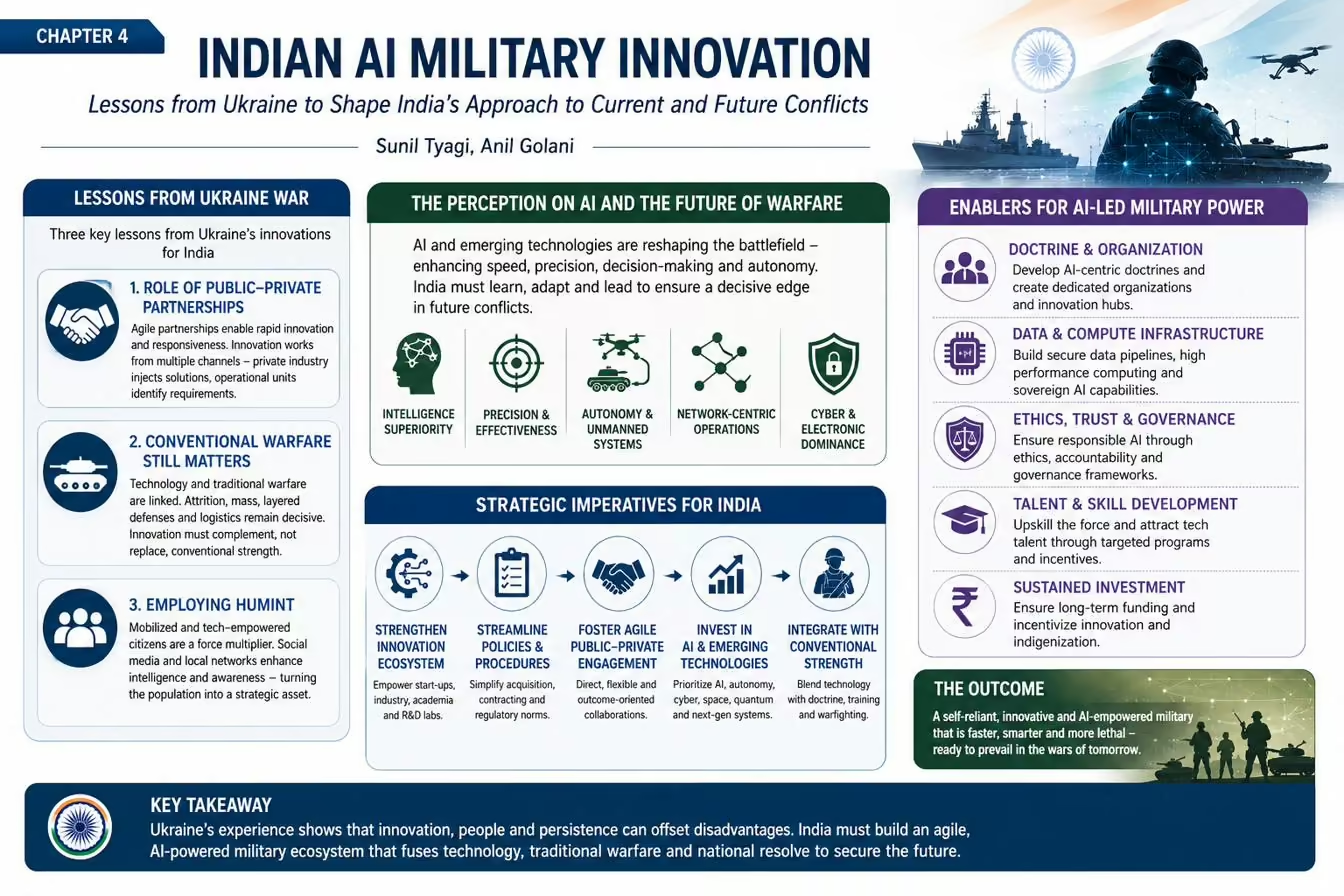
Tyagi S, Golani A. In: Cha J, editor. Global AI Military Innovation and Future of Warfare. National Assembly Futures Institute; 2024. p. 109–144. ISBN 979-11-94650-08-9 · Report at NAFI · PDF: Indian AI Military Innovation (chapter, with the report’s cover and contents; posted with the editor’s permission)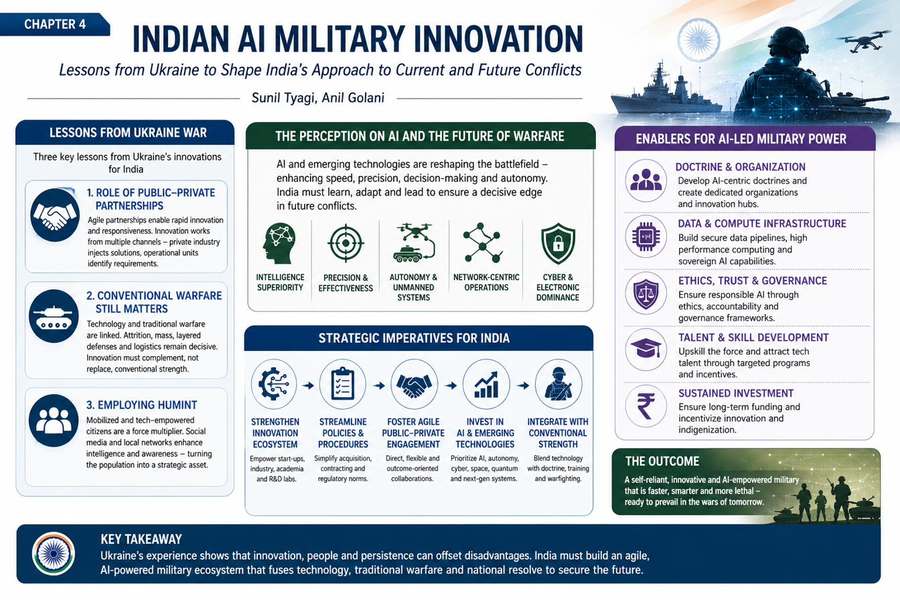
Journal papers
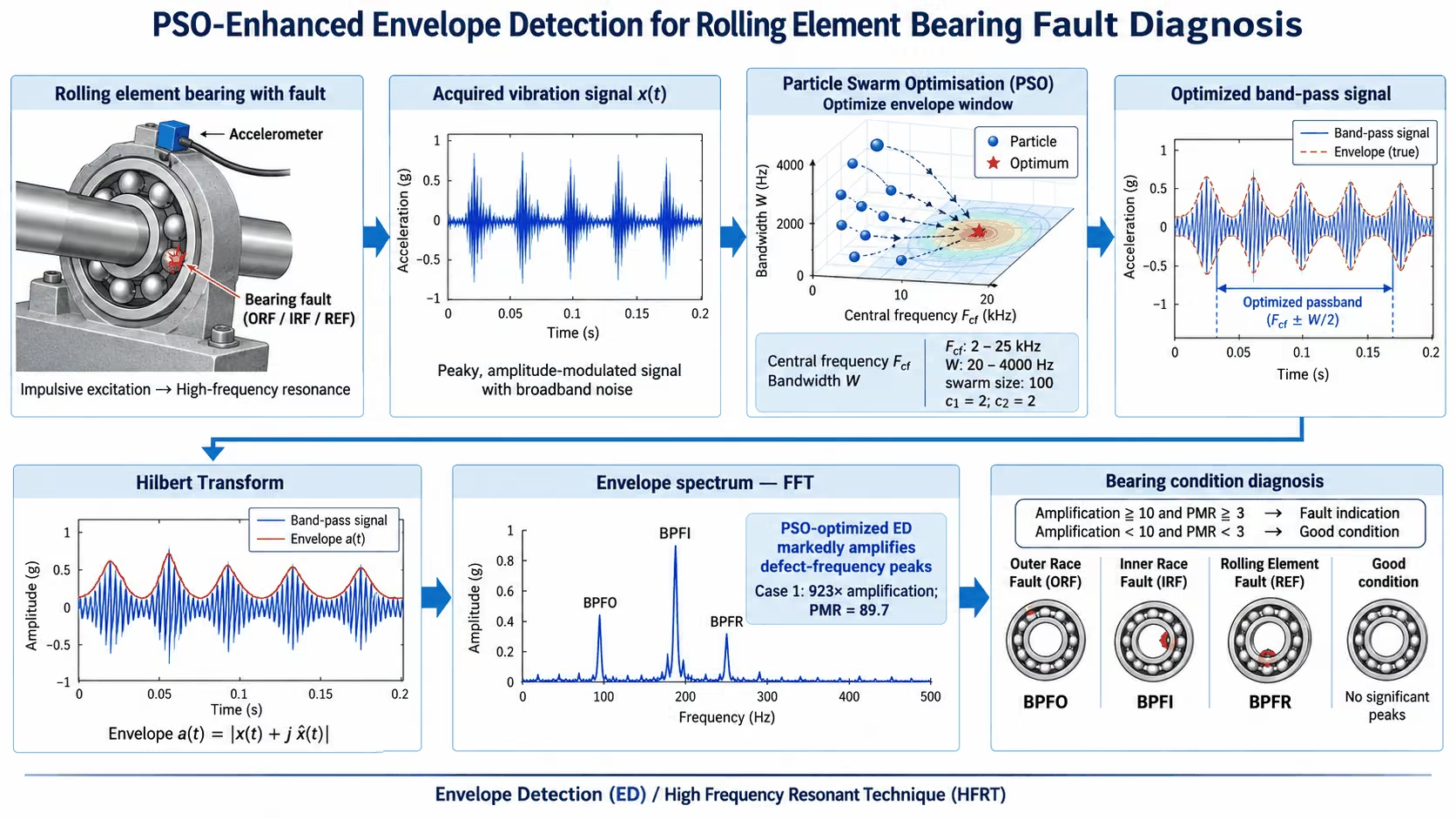
- An improved envelope detection method using particle swarm optimisation for rolling element bearing fault diagnosis
Particle swarm optimisation selects the envelope window (central frequency and bandwidth of the passband) for envelope detection of outer-race, inner-race and rolling-element bearing faults.
Tyagi S, Panigrahi SK. Journal of Computational Design and Engineering (Elsevier), 2017; 4(4): 305–317 · DOI · Article at Oxford Academic · PDF: An improved envelope detection method using particle swarm optimisation for rolling element bearing fault diagnosis (open access, CC BY-NC-ND)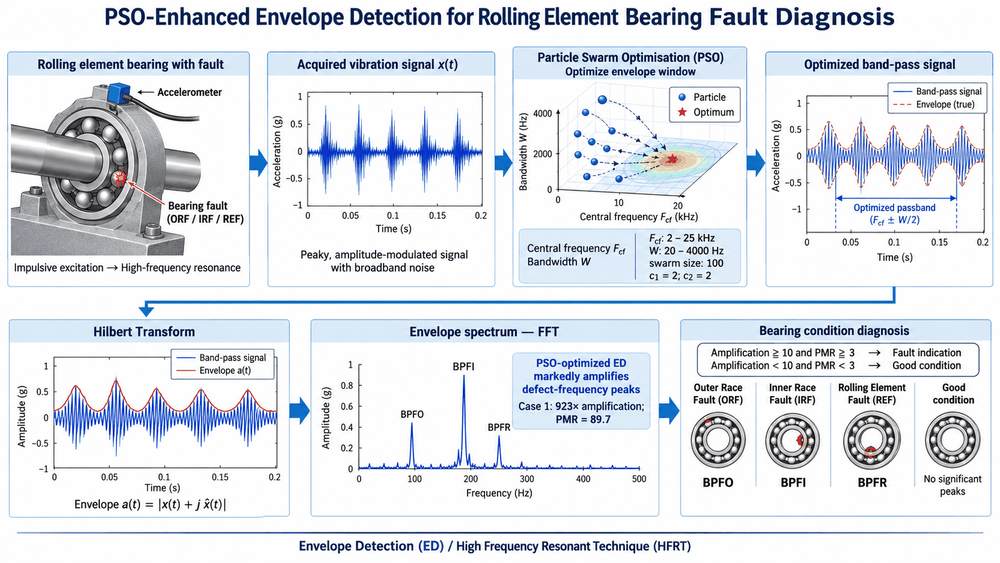
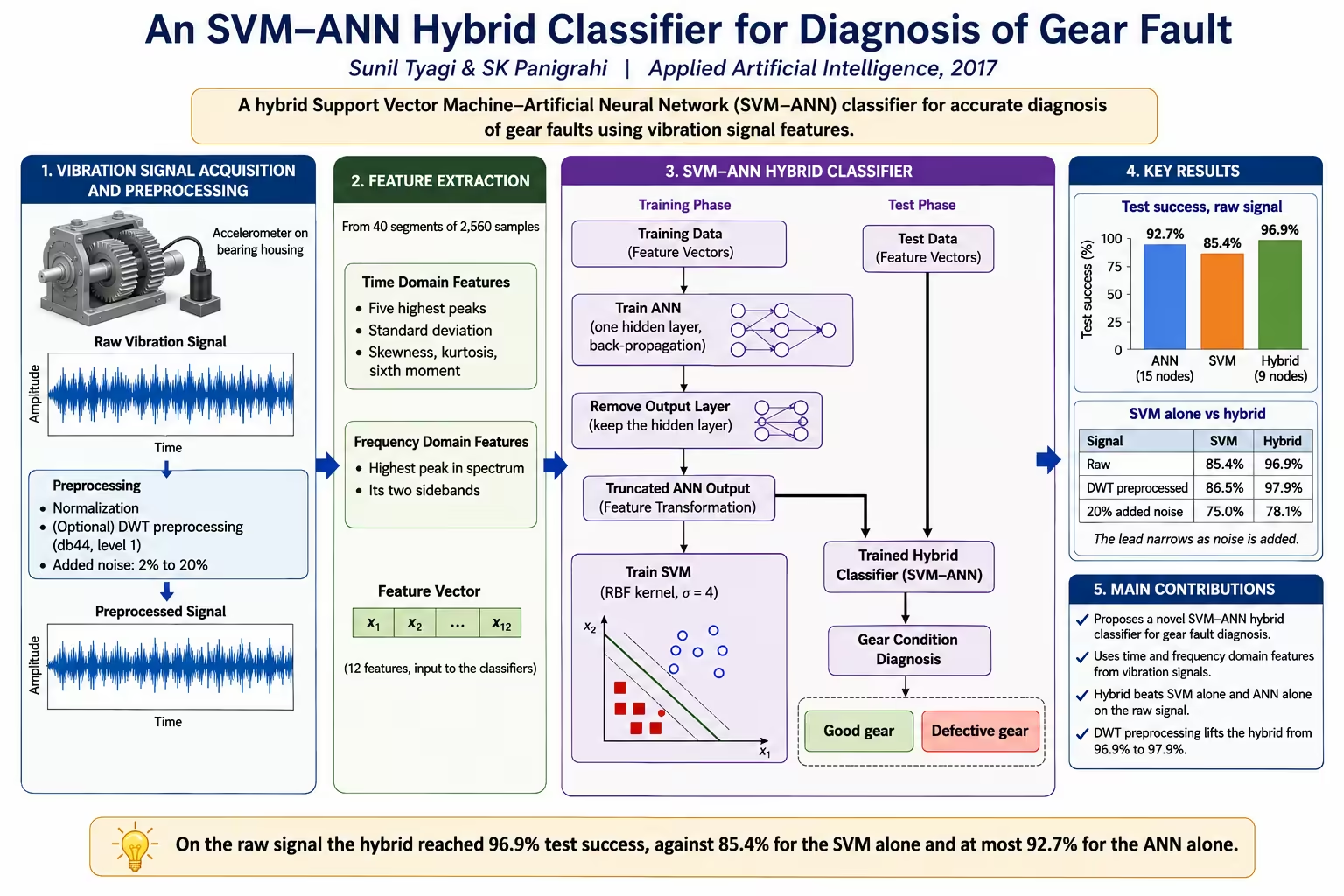
- An SVM–ANN hybrid classifier for diagnosis of gear fault
A hybrid of support vector machines and artificial neural networks diagnoses gear faults from gearbox vibration features, including under noise and with discrete wavelet transform pre-processing.
Tyagi S, Panigrahi SK. Applied Artificial Intelligence (Taylor & Francis), 2017; 31(3): 209–231 · DOI · PDF: An SVM–ANN hybrid classifier for diagnosis of gear fault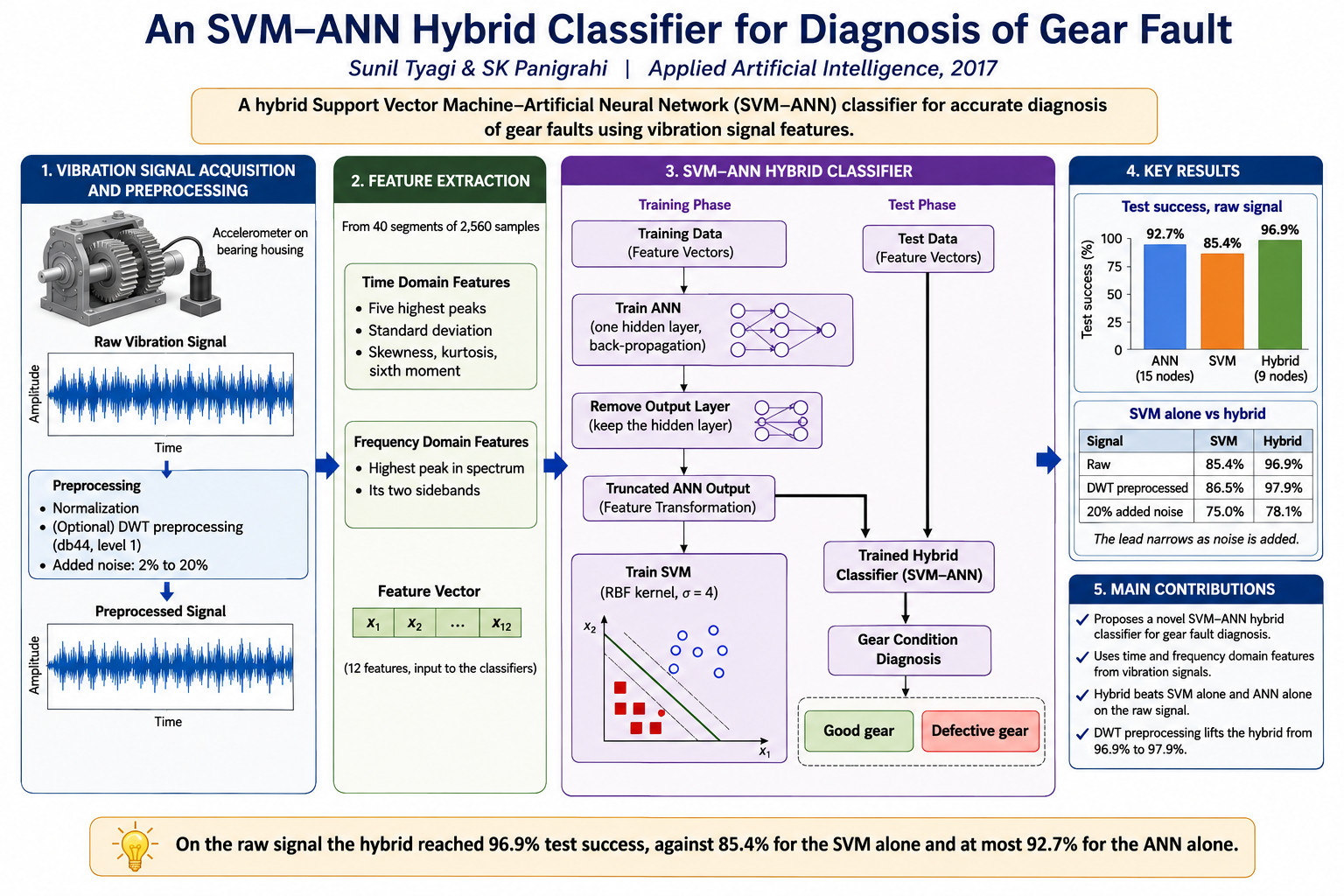
- A hybrid genetic algorithm and back-propagation classifier for gearbox fault diagnosis
A neural network trained by a hybrid genetic algorithm and back-propagation method diagnoses gear faults from gearbox vibration features, with and without discrete wavelet transform pre-processing.
Tyagi S, Panigrahi SK. Applied Artificial Intelligence (Taylor & Francis), 2017; 31(7–8): 593–612 · DOI · PDF: A hybrid genetic algorithm and back-propagation classifier for gearbox fault diagnosis - A DWT and SVM based method for rolling element bearing fault diagnosis and its comparison with artificial neural networks
A support vector machine classifier for rolling element bearing faults, compared with an artificial neural network, with and without discrete wavelet transform pre-processing of the vibration signal.
Tyagi S, Panigrahi SK. Journal of Applied and Computational Mechanics (Shahid Chamran University of Ahvaz), 2017; 3(1): 80–91 · DOI · PDF: A DWT and SVM based method for rolling element bearing fault diagnosis and its comparison with artificial neural networks (open access) - A simple continuous wavelet transform method for detection of rolling element bearing faults and its comparison with envelope detection
A continuous wavelet transform method for detecting rolling element bearing faults from vibration signals, compared with envelope detection on experimental data.
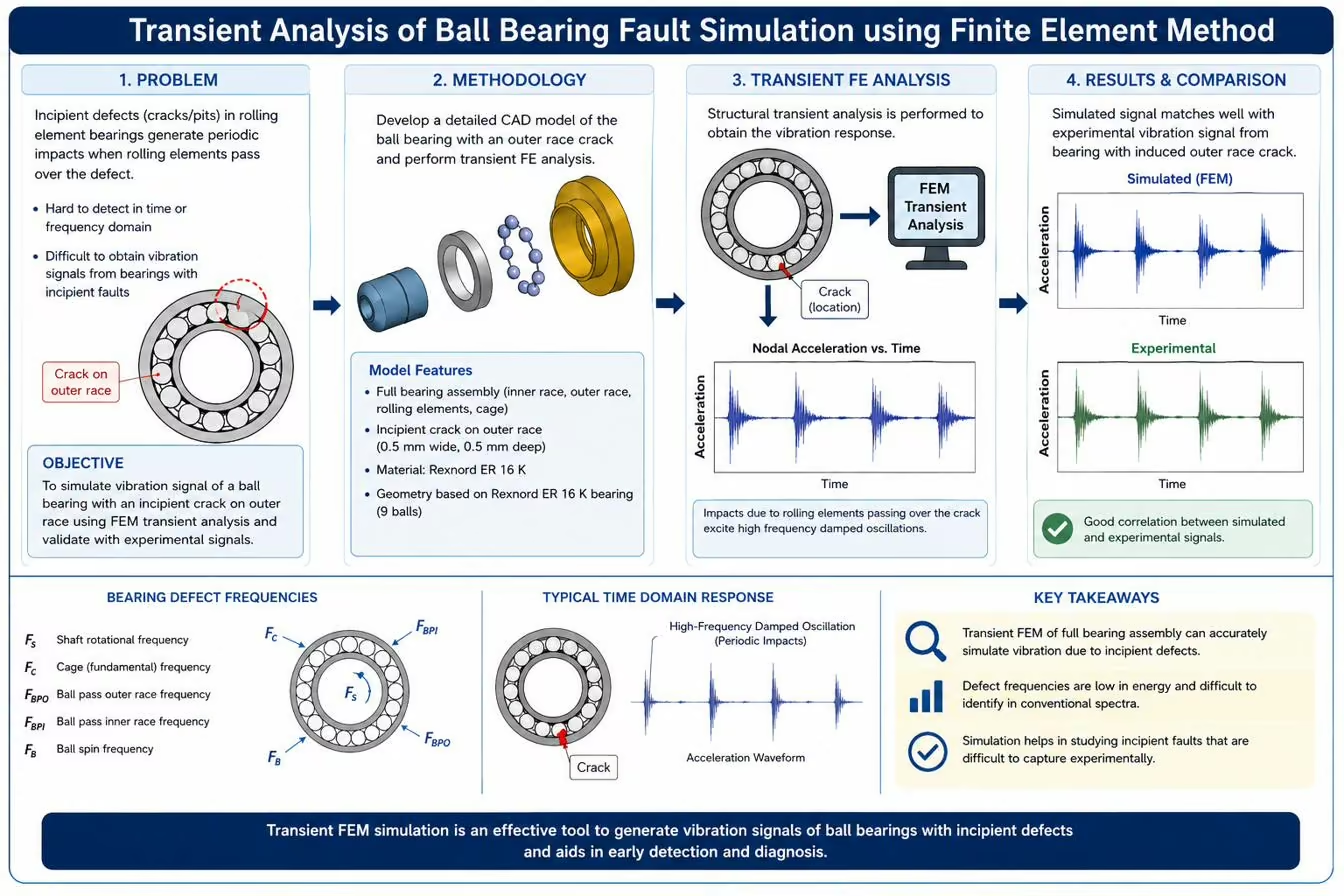
Tyagi S, Panigrahi SK. International Journal of Science and Research, 2017; 6(3): 1033–1040 · DOI · PDF: A simple continuous wavelet transform method for detection of rolling element bearing faults and its comparison with envelope detection (open access, CC BY) - Transient analysis of ball bearing fault simulation using finite element method
Transient finite element analysis of a ball bearing with a minor outer-race crack, simulating the vibration of an incipient fault, with results validated against experiments.
Tyagi S, Panigrahi SK. Journal of the Institution of Engineers (India): Series C (Springer), 2014; 95(4): 309–318 · DOI · PDF: Transient analysis of ball bearing fault simulation using finite element method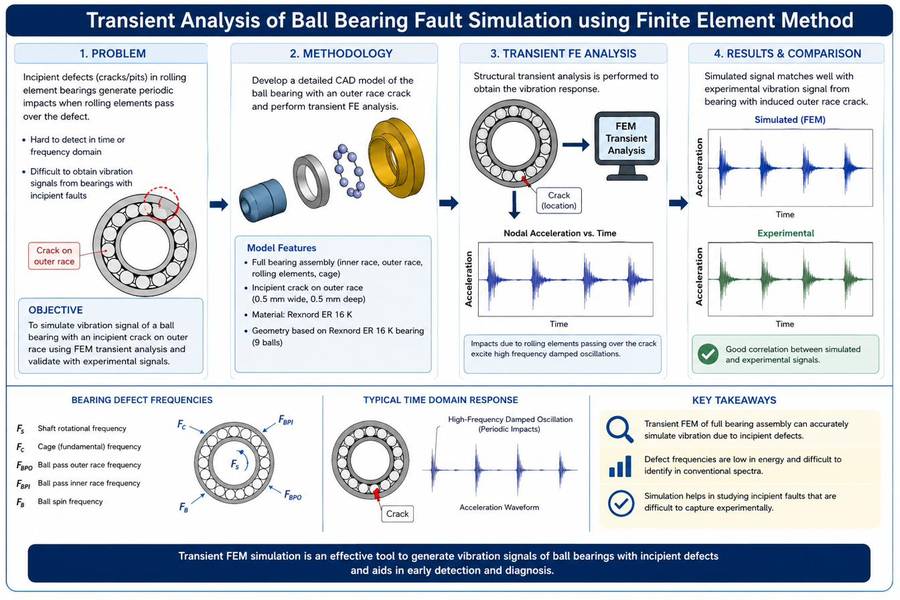
The 2014–2017 papers arise from PhD research at the Defence Institute of Advanced Technology, Pune. Indexed records: ORCID 0000-0001-5897-7955 · Scopus Author ID 57194035292 · Google Scholar.
Conference & early papers
- A comparative study of SVM classifiers and artificial neural networks application for rolling element bearing fault diagnosis using wavelet transform preprocessing
Artificial neural network and support vector machine classifiers for rolling element bearing faults, using statistical vibration features, with and without discrete wavelet transform pre-processing.
Tyagi S. International Journal of Mechanical and Mechatronics Engineering (World Academy of Science, Engineering and Technology), 2008; 2(7): 904–912 · DOI · PDF: A comparative study of SVM classifiers and artificial neural networks application for rolling element bearing fault diagnosis using wavelet transform preprocessing (open access; also at WASET) - Wavelet analysis and envelope detection for rolling element bearing fault diagnosis — a comparative study
Envelope detection with the fast Fourier transform compared with wavelet analysis for diagnosing rolling element bearing faults, on experimental vibration data.
Tyagi S. Proceedings of the 11th National Conference on Machines and Mechanisms (NaCoMM-2003), IIT Delhi, 2003; pp. 344–353 · DOI · PDF: Wavelet analysis and envelope detection for rolling element bearing fault diagnosis — a comparative study
Articles & commentary
- Lethal autonomous weapon systems: the future AI arsenal
What lethal autonomous weapon systems are, the AI techniques that give them autonomy (computer vision, reinforcement learning, decision trees and deep learning) with commercial and military examples, the debate at the United Nations, and how India might approach them.
Tyagi S. Defence Research and Studies (DRaS), 28 November 2023 · Article at DRaS - Reality, lies and automation: how AI-powered text generation models could cause chaos?
How deep-learning text generators such as ChatGPT, with a little human curation, can promote falsehoods on social media as a tool of information warfare.
Tyagi S. Journal of Defence Studies (Manohar Parrikar Institute for Defence Studies and Analyses), 2023; 17(2): 160–175 · Article at MP-IDSA · PDF: Reality, lies and automation: how AI-powered text generation models could cause chaos? - Sea of debt: China’s economic and strategic expansion in the Indian Ocean
China’s ‘debt trap’ diplomacy in the Indian Ocean region and its implications for geopolitics, economic stability and the balance of power there.
Tyagi S. Defence and Diplomacy Journal (Centre for Air Power Studies), 2023; 13(1): 91–104 · Author’s manuscript (PDF): Sea of debt: China’s economic and strategic expansion in the Indian Ocean - Did Turkey break the 1936 Montreux Convention to help Russia?
Tyagi S. CAPS In Focus 65/2022, Centre for Air Power Studies, 9 September 2022 · Article at CAPS
Working notes
- DEMON Analysis: Reading a Vessel’s Propulsion from Its Own Noise
Working note, 2026 — the physics, the Hilbert envelope, the harmonic comb, and a synthetic-data validation case study. - Building a Physics-Grounded Synthetic Underwater Acoustic Dataset for Self-Supervised Learning
Article, 2026 · open dataset (CC BY 4.0): Hugging Face, DOI 10.57967/hf/11191 · GitHub repository